
Ultimately, Stranger Things celebrates our love of story. We need more of all this in our lives
By Christopher Ryan
SPOILER WARNING: Yeah, I’m going to discuss details from the end of the Stranger Things finale. If you haven’t seen it yet, I encourage you to do so and come on back when you’ve finished. Thanks.
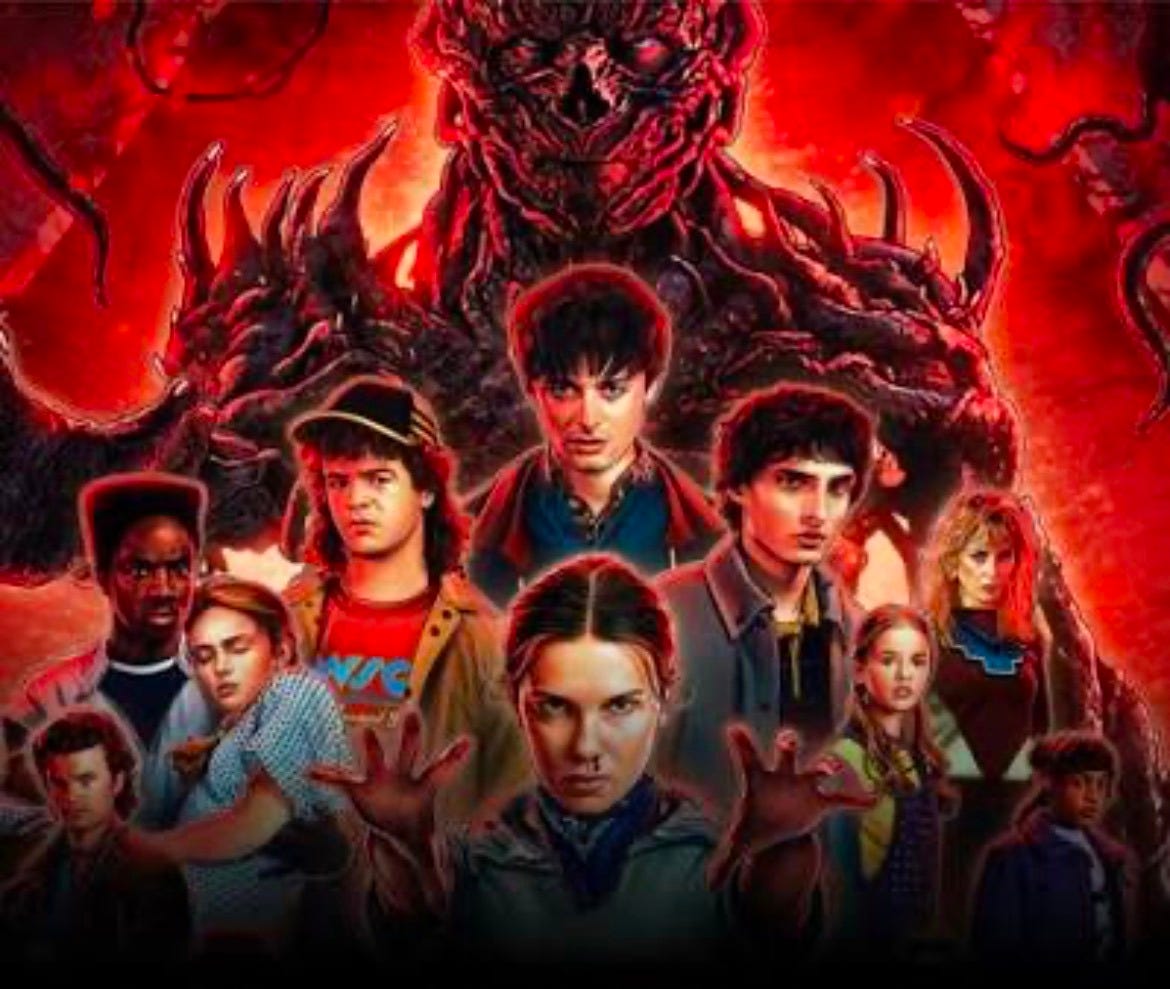
On Thursday, I wrote about how I view the Stranger Things finale, as I do the entire series, as perfectly imperfect. The idea that any of these shows (or anyone’s novels, music, art, films, or any other creative output) must reach spotless end-to-end perfection defeats the point of art, which is expression of the human experience. Not technically perfected genius, just the human experience. And the even the best of such efforts brings with it our emotions, hopes, dreams, nightmares, insecurities, and flaws. Creative self-expression has always been working through all of that to find the purer whole that helps so many of us navigate our own lives.
So I don’t care to pick nits.
I’m attracted to the big swings, the humane gestures of artists wanting to connect to their audience. And in this area, the Duffer Brothers delivered a sweet exploration of hope and belief at a time when there really isn’t a lot of either to go around.
In an appreciated bow to The Lord of The Rings trilogy’s extended coda, the Duffers give us a new one to enjoy. From Rockin’ Robin’s addressing her radio audience one last time after the 18 month time jump all the way to the credits, each sequence offers hope.
(By the way, I suggest the 18 month leap forward does all of us a favor. No one needed to watch what would require maybe another hour of story time to show legal wrangling, military withdrawal, lawsuits, Board of Education decisions to do academic things to allow all their students to graduate on time, etc. Thank you, Duffers.)
Rockin’ Robin’s radio moment serves at least two goals for the audience. First, to address the elephant in the room that is the time jump. That she discusses how the town seems so different, almost unrecognizable to her, addresses that nothing will ever be the same for our heroes, for the town, for all of us. In a real (storytelling) sense, these characters’ worlds were absolutely rocked by what they endured. If we weren’t impacted by these journeys, one would wonder why we spent all this time with them. Additionally, there is a slight but definite subtext in Robin’s words that subtlety comments on the changes going on in our real world. So, she’s right to note the world is almost unrecognizable, but it might be us.
Secondly, Robin’s scene serves as a transition to the graduation sequence, eventually. Initially, we get character moments. Lucas and Max. Dustin and his mother. Beyer family photos. The Mike and Hop grief discussion. Each shows us these characters moving back to real life, some easier than others, but getting back to the ordinary world. And every hero’s journey must return the hero (heroes here) back to the ordinary world changed in ways that make it impossible to go back to the way things were. The Duffers nail this requirement here rather well.
And that leads us to the graduation, and Dustin’s speech. His observations underscore how much they all grew past the high school horrors of peer groups and pecking order and bullying. And there is true nerd joy in watching Dustin mock conformity, rip off the “uniform” of tradition and honor Eddie as the positive rebel role model he became for Dustin. And a lot of us.
This brings us to every nerd’s biggest temptation: being invited to the cool people’s world. It is exceptionally satisfying that Mike rejects it in favor of “a much better idea”—going back to the basement for One. Last. D&D game.
This was a bookend so many wanted, including the Duffers. And it works as the classic storytelling technique it is. Going back to how the tale opened allows us to see how much the characters have changed and how they are also still the good people we chose to follow way back at the beginning.
Adding Max to the game, and seeing her so accurately reacting the way Max’s character would suggests both elements. But her behavior and challenge to Dungeon Master Mike’s story wrap not only serves her character but advances all of us beyond what we expected of this scene to the wonderful storyteller’s sequence.
And Mike as storyteller does so much. It reminds us of his initial role, nudges us to remember we are here for story, nods to the fact that we’ve all just been through an extended, harrowing, five-season-long D&D campaign together, and does a fun spin on that 80’s trope of the “what happens to” stills that used to play during the credits of some of the hit movies this show celebrates. Bravo.
Most importantly, it challenges us to believe.
To believe that Eleven might still be out there (metaphorically, that the special world of story might still exist in our own lives).
To believe in story as a tool that helps us navigate our own lives.
To believe in the hope that story nourishes.
We need such a hope these days.
The truth is, we’ve always needed story since our species earliest tales around primordial fires. Sharing stories have urged our humanity forward for almost as long as there have been humans.
I suspect those who have embraced the power of story in their lives are better off than those who never invested in such joys. Our current times might prove that in increasing uncomfortable ways.
So here’s to storytelling, and perhaps most importantly, believing in the power of story in our lives.
Believe, my brothers and sisters. Believe.

 Chris Ryan