Let It Suck Series:  Covers Get Rewrites Too

We’ve been talking about leaping into writing your story and not worrying. Just getting the story onto the page or screen is a huge accomplishment, makes the rewrite process a joy. Or at least easier.

Same goes for covers.

I am about to make my YA debut with a sci-fi-tinged thriller called GENIUS HIGH. After much thought on the cover design, I narrowed it down to one concept that stayed with me: graffiti and a bloody hand print on a locker angled so we can see far down the hall along a line of lockers. The graffiti would be the novel’s title. 

So I got the props I needed (dry erase marker, blood-like substance, SmartPhone with a good camera) and went to a school I know.

Here’s my first draft:


I took about 15-20 shots, and then sent the best three to my graphic designer, the always fantastic Liz Sheehan. She asked a bunch of questions, requested a blurb and some chapters, and that I write the “front matter” (all the copy that goes on the front of the book).

Here’s my first draft of the  “front matter”:

“Raised IQs and better test scores, what could go wrong?

Everything.

GENIUS HIGH

By Christopher Ryan

A Seamus and Nunzio Production YA novel”

Okay, that sounded pretty good to me, and I liked the image I sent. Here’s what Liz did with it. 

First version:


Pretty cool, right? She replaced my awful handwriting with a more stylized title logo, and designed the placement of  the front matter to make it look good. Liz’s spacing on “Everything” really worked. 

Pretty exciting, right?

But in the email, she sent another version:
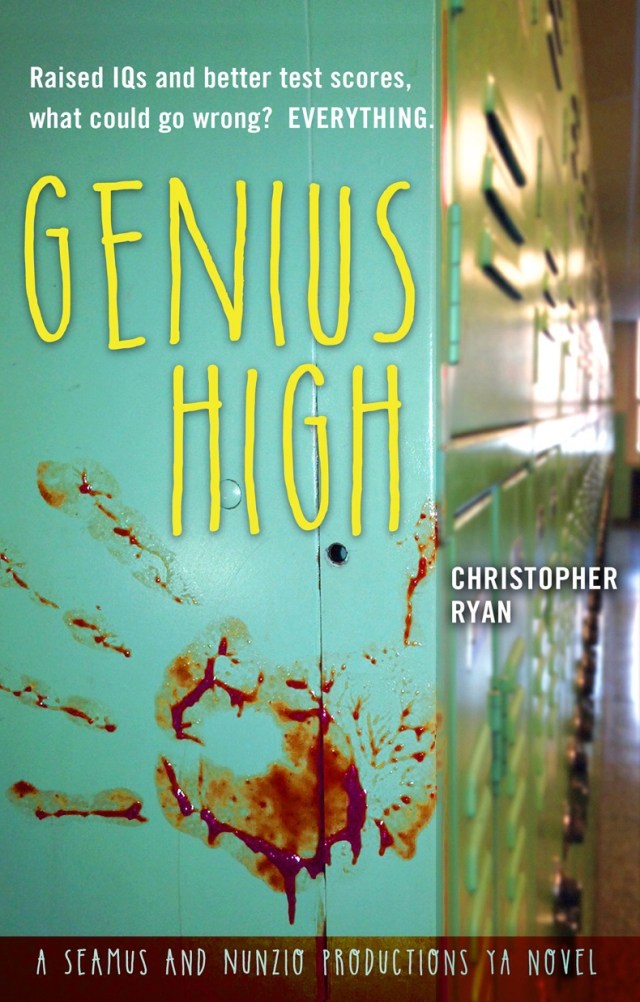
  

The color scheme and logo changed, the tag line placement shifted, “Everything.” became “EVERYTHING.” and suddenly, there was no other choice. This cover works better than the original concept, and it is important to be open to the possibility that yours might not be the best idea. This version looked right, and to test this, I showed some students. They voted for this one 16-3-1 (the three abstained).

So we’re done, right?

Nope. 

A rising pop culture non-fiction writer and friend, Caseen Gaines (who is about to publish WE DON’T NEED NO ROADS- The Making of the Back to the Future Trilogy), gave some critical feedback on the front matter, rewriting it to read:

“Raised IQs. Higher test scores. What could be wrong?

EVERYTHING.”

His changed “go” to “be” intrigued me, and I wrestled with the two versions for a long time, finally seeing that “be” has wider moral implications that “go” and I wanted those implications, they gave a better hint as to the themes of the novel.

He also said he “liked the red banner at the bottom but I don’t think I’d put Seamus and Nunzio Productions on the front. It’s wordy, and I don’t usually see a publisher’s info on the front cover of a book prominently displayed like that. I’d replace the text with “A YOUNG ADULT NOVEL”.

Gaines was right again.

The challenge here is to take feedback objectively rather than personally. Even though the front matter was my writing, both of Caseen’s suggestions improved the look of the front cover. Always go with good advice! When I asked Liz, she agreed. So, the front is getting a “rewrite”. 

Book covers are key to sales, so apply every “let it suck” lesson you know toward honing the image and messages on front to the very best they can be. Rewrite, redesign, simplify, clarify, and beautiful. That’s how your cover will go from suck to success. 

(When the back design is done, I’ll tell that tale as well.)

Keep writing and rewriting, brothers and sisters!

</ Ryan is author of City of Woe, available on Kindle and in print. For more info, click here.<

Posted in digital publishing, ebook publishing, education, fiction, independent publishing, pop culture, self-publishing, teaching, writing | Tagged , , , , , , , , , , , , , , , , , , , , , , , , , , , , , , , , , , , , , , , , , , , , , , , , , , , , , , , , , , , , , , , , , , , , , , , , , , , , , , , , , , , | Leave a comment

Let It Suck Series: To Write Better Dialogue, Listen to Craig Ferguson (revisited)

Pulling some of my previous blogs into the “let it suck” series. This one borrows simple advice from a great comedian to help you with character dialogue.

Here we go:

Every fiction author wants to write great dialogue. While there is almost too much advice out there regarding this topic, the best advice may come from an unexpected source – famed and respected comedian Craig Ferguson.

The most prevelant problem emerging authors have with dialogue is overwriting, tending to let conversations go on too long, burden it with too much exposition, or make it suffer from stilted, unnatural cadences. 

Not to worry, Craig Ferguson is here to save the day.

Ferguson is hilarious about many subjects, but one of his more famous bits – which is actually about keeping peace in a marriage – is also helpful when writing dialogue.  He says, “There are three things you must always ask yourself before you say anything. 1) ‘Does this need to be said?’ 2) ‘Does this need to be said by me?’ 3) ‘Does this need to be said by me now?'”

As funny as that is when applied to keeping relationships happy, adjusting each question slightly gives us great advice on writing dialogue:                                                                                                                                                        

1)  Does this need to be said at all? (Can the information be presented or summarized or alluded to some other way? If so, then write it some other way.)                                                                                                                                                                                               

2) Does this need to be said by this character? (Will the story be better served if this information comes from some other character? Why or why not? Find the answer. Serve the story.)                                                                                                                                                        

3) Does this need to be said by this character at this point in the story? (Will it be more effective earlier or later in the narrative? Why or why not? Again, find the answer and serve the story.)

Asking yourself these questions while either preplanning your story or as you write – and being very honest with yourself (rationalization is always one of a writer’s toughest enemies) will help keep dialogue tight and lIvely and functioning at its best.

Good luck, and keep writing.


</ Ryan is author of City of Woe, available on Kindle and in print. For more info, click here.<

Posted in comics, digital publishing, ebook publishing, education, fiction, film, independent publishing, self-publishing, Uncategorized, writing | Tagged , , , , , , , , , , , , , , , , , , , , , , , , , , , , , , , , , , , , , , , , , , , , , , , , , , , , , , , , , , , , , , , , , , , , , , , , , , , , , , , , , , , , , , , , , , | 2 Comments

Let It Suck Series: What Would Your Character Do?

We’ve agreed to “let it suck” on first draft, yes? Just let it rip with the writing and get a draft completed. And we’ve been discussing ways to find and refine your work during rewrite. 

Now let’s let the character share the workload, okay?

I reposted a character profile questionnaire to help you really get to know your characters. Yes, it is a lonnnnnnng list of questions, but if you are serious about telling your story, discovering the answer to each of these for your characters (at least the major ones, although the more you know about everybody in your story, the more authentic your writing will be), the better informed your writing will be.

This discussion is about that process. How does knowing your character alter the telling of your tale? It is a simple case of What Would Your Character Do?

Let’s say your hero is battling enemies. Would s/he use weapons? What kind? Would s/he kill? Knowing the answers to such “questions of moment” significantly change the scene. And knowing the right answer for your character specifically makes all the difference.

How do you get the answers? The character profile questionnaire will help because, as goofy as it sounds, the more you know your characters as “real” people, the more you know what they would do (you know how a family member will react to things, or a friend, or partner, or boss, right? This is the same kind of thing).

For example, in the late 1930s, when Batman first appeared, he would toss bad guys off roofs or shoot them. But then he didn’t. Why? The storytellers made a key decision based on specifically knowing Bruce Wayne: Due to the pain and trauma of witnessing his parents’ murder as a child, Batman doesn’t kill. This one answer to a single character question has propelled this particular character on a far more difficult and rewarding road for 70 years.  There have been many intriguing stories exploring why he doesn’t kill, especially someone like the Joker, an antagonist supremely worthy of death. Not killing the Joker pushes Batman into a difficult moral corner, and, as Robert McKee has said, this is where character is revealed.

To kill or not to kill is just one ongoing character question, and all such considerations help define what characters do. In the 1930s and onward, The Shadow killed, Doc Savage did not (he used the equivalent of rubber bullets, and, most often, his big bronze fists). This major difference helped define each series.

Now take this example a step further. For something like 30 years (the 50s to the 80s), no comic book hero killed. Again, this wasn’t always the case. For most of their history, comic book heroes did not kill, mostly due to the Comics Code. When creators finally began dismissing that policy as the hollow political posturing it was, things changed. Some characters got darker, some killed, and this changed comics. Books like The Punisher, Sin City, and Preacher became known for death and chaos and violence. This had a significant -and not necessarily positive- effect on the entire genre. For example, as a more or less direct result of the darker morality of comics over the last 20 years Batman has had to deal with the increasingly horrific price of upholding his vow, leading some to interpret him as being as psychotic as the villains he faces (not a theory to which I subscribe). 

In film, many Marvel characters kill. Mostly, they kill people trying to kill them, but there has been unsettling collateral damage during major battles (see Man of Steel or Marvel’s two Avengers flicks) and at least in Superman’s case, it caused much heated debate about whether he fulfilled the concept of hero as a result. All of this from various creatives answering one question.
Your question may be simpler. Carnivore or vegetarian? The answer will impact a first date scene. Allergies or no? How could that alter a scene wherein a character is hiding? Liar or no? Changes dialogue. Two liars? The dialogue scene grows more complicated. Two liars who know each is lying? More complicated still.

I am currently writing a short adventure tale featuring an internationally known soldier of fortune called Blackjack, who was created by my good friend Alex Simmons. In this story, Aaron Day (aka Blackjack) goes to a ruined Egyptian city to help the survivors there defend what remains of their home from marauders. He believes they should just leave, but Blackjack does much of what he does because of a belief system passed down, in one way or another, from his father. This causes him to respect the survivors hopeless cause, and make decisions with that in mind, even though that respect causes complications and increased danger to himself steadily throughout the story.

Knowing who Blackjack is has informed my decisions throughout rewrites. The story is far more complicated and rewarding than it was in the first draft because knowing the belief systems of both the hero and the survivors made demands on how I serve the story. Further, knowing the character has also influenced dialogue (Blackjack knows some Arabic) and action (he shows patience where a character like Wolverine would have cut someone).

Knowledge is power. Thorough knowledge will empower your writing. So let the first draft suck, then ask yourself, at each step of your rewrite, what would your characters do, and you’ll see the richer writing emerge. 


Art by Tim Fielder. Blackjack created by Alex Simmons.

</ Ryan is author of City of Woe, available on Kindle and in print. For more info, click here.<

Posted in America, comics, digital publishing, ebook publishing, education, fiction, film, independent publishing, Marvel, Marvel Cinematic Universe, pop culture, self-publishing, super-heroes, teaching, The Walking Dead, Uncategorized, writing | Tagged , , , , , , , , , , , , , , , , , , , , , , , , , , , , , , , , , , , , , , , , , , , , , , , , , , , , , , , , , , , , , , , , , , , , , , , , , , , , , , , , , , , , , , , , , , , , , , , , , | Leave a comment

Let It Suck Series: revisiting “Write Better With Character Profiles”

As part of the “Let It Suck” series of posts, I wanted to discuss how knowledge of your characters informs writing decisions, and this post seems crucial to include, so I am reprinting it as a companion to this week’s new post. I hope it helps.

Here we go….

Screenwriting guru Syd Field once wrote “Plot is character, character is plot” He was and continues to be right. If we want to improve our stories, one way to do so is to improve our characters.

How? Well, the more we know about a character the more choices we will have when writing about him or her. 

One great way to get to know your characters is by filling out a profile sheet on each of them.

Writers who know deep background on their character write with more authority and depth about those characters. No bit of knowledge is too small; everything informs. I’ve created the character profile below after losing a cherished profile given to me in a writing class long, long ago in a college far, far back in my memory.

Is this one complete? Probably not, but these 110 profile elements definitely will serve as a strong start and work well in getting you to really know your characters. Feel free to fill out a profile for as many of your characters as you need. The more the better. 

With that in mind, open up to these questions, answer them thoughtfully, and you will find yourself knowing your characters and writing about them with significantly more confidence and depth.

Have fun.

CHARACTER PROFILE

Name

Age

Gender

Left/right handed

Hair color

Hair length

Hair style

Eye color

Vision (20/20, 20/60….)

Height

Weight

Measurements (men) chest/waist/inseam (women) bust/waist/hips

Build (athletic/flabby/thin/wide…)

Health status

Posture

Shoe size

Clothing sizes

Preferred style of dress

Style of work clothes (suit/uniform/casual…)

Style of non-work clothes (sweater/rock group T-shirt, button down, crop top…)

Financial account balances (savings/checking/credit cards/loans/stocks…..)

Occupation

Yearly salary

Benefits

Work schedule/hours

Length of time at that job

Career history

What did character want to be as a child?

What did character want to be as a college student?

How did character get from those aspirations to where s/he is now?

Favorite job and why

Worst job and why

Dream job

Nightmare job

Plans for retirement

Passions away from work

What does this person do with his/her free time?

What does s/he do most often when by her/himself?

Full current address

Birthplace

Where did s/he grow up?

What was that place like?

With whom did s/he grow up?

Best childhood memory

Worst childhood memory

Childhood friend

Still in contact with that childhood friend? Why or why not?

First sexual encounter (who? What? Where? Why? How?)

Best sexual experience and why

Worst sexual experience and why

First love (where did they meet? How did the relationship start? How long did it last? How deep into the relationship -physically and emotionally a did it go? Why and how did it end?)

How was his/her school experience?

Best school memory and why

Worst school memory and why

Favorite subject and why

Least favorite subject and why

Favorite teacher and why

Favorite quote from teacher

Least favorite teacher and why

Scariest moment from childhood and why

Funniest moment from childhood and why

Best moment with a parent and why

Worst moment with a parent and why

Parents jobs

Parents financial picture while character was growing up

Favorite teen memory

Worst teen memory

Favorite college (or early 20s) memory/moment

Worst college (or early 20s) memory/moment

What pushes his/her buttons/gets him/her angry?

Turn ons

Turn offs

Pets? Explain

 Eating habits

Drinking habits

Favorite meal

Favorite beverage

Favorite snack when happy

Favorite snack when sad or angry

Is s/he handy with tools?

Workout regimen

Reading habits

Online habits

What tech does s/he use and how often/ how well/for what reasons?

What social media does s/he use how often and how well and for what reason?

Has character ever used online dating?

Ever have a one night stand?

Ever have an unusual romantic encounter?

Ever cheated on someone?

Ever been cheated one?

Any unusual encounters?

Religious upbringing

Current religious level of affiliations or reason character abandoned religion

Political affiliations or beliefs

All-time favorite movie and why

All-time favorite song and why

All-time favorite book and why

All-time favorite television show and why

Which sports teams does character root for and why

How are character’s sleep patterns?

Average hours of sleep per session?

Restful or fitful sleep? Why?

Favorite physical activity

How well can character run and why?

Does character tend to be hot, cold, or comfortable in his/her environment?

Local weather?

Describe community where character lives – country? Suburbs? City? Outer space?

Describe the environment where the character works in exacting detail

What does s/he dream of these days?

  
</ Ryan is author of City of Woe, available on Kindle and in print. For more info, click here.<
Posted in comics, digital publishing, ebook publishing, fiction, film, independent publishing, self-publishing, writing | Tagged , , , , , , , , , , , , , , , , , , , , , , , , , , , , , , , , , , , , , , , , , , , , , , , , , , , , , , , , , , , , , , , , , , , , , , , , , , , , , , , , , , , , , , , | 6 Comments

Let it suck series: Setting up setting

Elmore Leonard famously advised writers to “try to avoid the parts that readers skip”. This is a definite risk when it comes to describing where your characters are, so listen to the master when dealing with setting.

I tend to underwrite setting, especially in the first draft during which we have agreed to “let it suck”. Have a scene in a library? As you work through the first draft, it will probably be enough to write, “Sharkey and Mack entered the library.” Get the story down now, add in additional setting details during rewrite.

But what is necessary and what is too much?

The golden rule, of course, is you must serve the story. Once you have your draft down, walk away. Go mow the lawn, change a diaper, have a catch with your kids, toil at your day job, take a walk. And in the back of your head, ask the following questions:

What does the scene absolutely have to do?

How can this setting help or hinder the protagonist, the antagonist, etc.?

What elements of this setting can be briefly mentioned to help establish mood, foreshadow events, or payoff some plot or character element?

Live the answers so they become part of your tale.

Then review the scene’s setting in terms of the five senses; how does it look, smell, sound, taste, feel? The more of these you can use, the stronger connection you will provide for your readers.

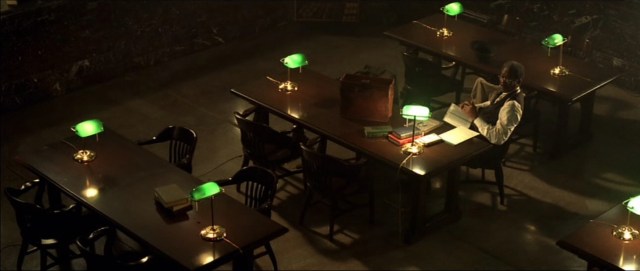
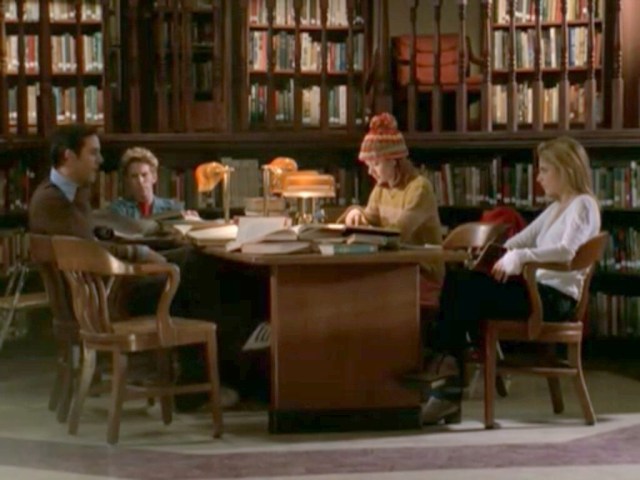
Let’s use the library as an example. If it is old and Ivy League that is very different than a smaller, more modern suburban town library, and that difference will an effect on the story. Look at the library in the film Seven and the one used as a central location for several seasons of Buffy The Vampire Slayer. They are fundamentally different, and create very different spaces in which to tell their respective tales.

How does the library smell? Think about how each the following answers fundamentally changes the scene: stacks of old books, a whiff of French perfume known to be worn by the killer, lilac air freshener, fire, hot buttered popcorn,  way too much Old Spice, whiskey, the unmistakeable stench of decomposing human flesh. Now mix and match and you see how smell can shape setting.

Sound does similar work. How does each of the following hit a reader’s “ear” as s/he reads? The full quiet of many people working silently. The insistent tick of a clock. The quiet whimpering of one terrified person hiding in the stacks. Two kids giggling quietly. The sighs of quiet sex.  The rustling of clothes being re-arranged quickly. The unmistakeable sound of a shotgun being locked and loaded.

What is the taste of a library? Stale air? Peppermints in a candy tray at the checkout counter? The copper taste of blood in the air? See how these few possibilities alter setting?

Feel is not in a character’s heart. Keep it exterior. The squish of a rug wet with blood. Thetexture of the old tome needed to save the world. The love letter’s delicate stationary in her hand. His rough palm on the frightened girl’s bare shoulder.

Get your setting down simply, then live in your setting as you go about your day. Finally, go back and fill in only the nuances that serve your story, and your setting will be an effective, crucial part of your story’s success.


Christopher Ryan is author of City of Woe, available on Kindle and Nook, and in print. For more info,click here.</em

Posted in comics, digital publishing, ebook publishing, fiction, film, pop culture, self-publishing, writing | Tagged , , , , , , , , , , , , , , , , , , , , , , , , , , , , , , , , , , , , , , , , , , , , , , , , , , , , , , , , , , , , , , , , , , , , , , , , , , , , , , , , , , , , , , | Leave a comment

Let It Suck Series: overwrite the scene, then pick up the scalpel

As we move beyond the blank screen and into our efforts as writers, we need to deal with scene work. The conventional wisdom is “enter the scene as late as possible and leave as soon as you can”, and I agree with that, eventually.

But not during a first draft.

When starting to write a scene, focus on the characters, the moment, and then leap in. Overwrite. Start with “Hello” or “Nice weather” if you have to, just get the scene written.

Yes, let it suck.

The main idea of the scene will be expressed in an overwritten draft, and getting the main idea down is our sacred duty.

After that, we just need to trim the fat.

Okay, first we may need to chop off huge chunks of fat like “Hello. Nice weather we’re having, isn’t it?” And here’s the key: that’s okay. It is early draft stuff, not what we are publishing. Once the scene is written in basic, and maybe flabby, form, we can highlight and cut, hold our finger down on the delete button, whatever it takes to get the scene into the form it needs to have before we share it with readers.

So, how do we do that?

Again, the answer is simple. We make it suck less. Going through the written scene asking ourselves, “is this necessary”, “can this be said better, more succinctly, more efficiently” and asking the most holy of questions, “does this serve the story” will get us through most of the cuts. 

Some may ask, “But what if I’m not sure about making a certain edit?” My answer comes from one of the ridiculous amount of books I’ve read about writing, and I am sorry to say I do not remember where exactly it comes from (if you do, please let me know and I will give the proper credit). Here’s the answer to editing worries: the extras file. 

Let’s say we are writing the soon-to-be-legendary “The Return of Jenkins” and need to do an edit we aren’t sure about. All we need to do is open a new document, let’s name it “Jenkins extras”, and then make the worrisome edit by cutting it from our story and pasting it into the “Jenkins extras” file. Now it is safe and can be retrieved if needed. No worries.

When I first read this, I had my doubts. I thought it would create a ton of extra work as I switched back and forth from the two files reducing myself to a puddle of insecurities. However, the text I read predicted this worry and promised that 99 percent of the material put in the extras file would remain there as I saw it was unnecessary to the story. This has proven to be overwhelmingly true.

So we are all set to overwrite without worry and edit without fear until we have lean and powerful scenes and learn to write more economically by overdoing it at first and cutting back to serve the story. Soon we find ourselves starting our scenes later and leaving them earlier, and still going back and trimming as needed, and we’re on the road to becoming editorial surgeons responsible for producing excellent written work.

Congratulations, doctor, it’s a classic.


Christopher Ryan is author of City of Woe, available on Kindle and Nook, and in print. For more info,click here.</em

Posted in digital publishing, ebook publishing, fiction, independent publishing, pop culture, self-publishing, writing | Tagged , , , , , , , , , , , , , , , , , , , , , , , , , , , , , , , , , , , , , , , , , , , , , , , , , , , , , , , , , , , , , , , , , , , , , , , , , , , , , , , , , , , , , , , , , | 2 Comments

Let it suck revisited: the beginning of a series


Awhile back, I wrote the following blog, which basically advised people to push beyond fears about instant quality in writing and just “let it suck. I reprint it here as the beginning of a series of blog posts that focus on getting beyond fears about writing an immediate classic and just doing the work.

Here we go:

There seems to be an abundance of writing advice on social media today, for which I am thankful. To return the favor, I want to offer writing advice I give my students: LET IT SUCK. 

This advice may sound odd but it is based on the soundest of principles: Writing that sucks is infinitely easier to improve than a blank page (digital or other). Simple as that. If you allow yourself to just write a draft without worrying about wonderfulness, yes, some of it will suck.  

Don’t worry, the sucky parts are easy to fix.

 As dumb as it sounds, just ask yourself why the sucky part sucks (without having a meltdown) and you will see that, for example, a sentence sucks because it should actually be phrased differently, or a character would never do that, she would do this, or there is a repetitious phrase, etc.  

The revelation here is that none of the “sucky parts” are insurmountable, and most often you correct these issues quickly.  And, most importantly, the page is no longer blank.  

Once you have a quick draft done, the job is just to move to an area of suck, address that, and then go to the next area of suck. 

Each fix makes the work suck less. And you, my friend are being productive.  

How do you know when it is great? When you have been through it twice and know deep inside that now you are just fussing. This is when you are ready for the big test: reading it out loud.  

Don’t scoff, this is a necessary step. Reading your work out loud, in a voice and at a pace you would use when reading publicly for money, will reveal all the hidden flaws your eyes and ego hid. 

Don’t meltdown over this either, just mark it, and continue with your “public reading”. 

I print out my copy to do this step; it is easier to mark with a highlighter and move on than to start rewriting in the middle of a “public read”. And yes, reading it again after all this new round of fixes is key to make sure your writing is as nearly perfect as you can make it.  

So, let it suck, then make it suck less, and suck less, and suck less, until it is, much to your shock and delight, great.  

 Keep writing, brothers and sisters.  

 Christopher Ryan is author of City of Woe, available on Kindle and Nook, and in print. For more info,click here.</em

Posted in digital publishing, ebook publishing, fiction, independent publishing, self-publishing, writing | Tagged , , , , , , , , , , , , , , , , , , , , , , , , , , , , , , , , , , , , , , , , , , , , , , , , , , , , , , , , , , , , , , , , , , , , , , , , , , , , , , , , , , , , , | Leave a comment

Creativity Worth Talking About

For those of you who have enjoyed my blog posts about writing and creativity, this new show may be perfect for you:

https://youtu.be/HyNRNm6fx3s
  

</ Ryan is author of City of Woe, available on Kindle and in print. For more info, click here.<
Posted in America, comics, digital publishing, ebook publishing, education, fiction, film, independent publishing, Marvel, Marvel Cinematic Universe, pop culture, self-publishing, teaching, writing | Tagged , , , , , , , , , | Leave a comment

The Power of “What If”?

Writing is an optimistic enterprise. Even the most cynical writer, the one who believes everyone is corrupt and the world is doomed, if that person still writes, s/he proves hope is alive. If that person truly believes nothing matters, why write? So, if we write, we have hope.

And that is necessary to unlock creativity. Hope fuels our ability to ask “What if?” And if we can ask that question and entertain an answer, anything is possible.

“What if” opens us up to reflecting our own lives, or something we’ve read, listened to, seen, tasted, felt. Whatever comes in and can be redirected creatively to offer an answer.

That answer has turned into The Lord of The Rings, Hamlet, The Outsiders, Something Blue, Imagine, Pride and Prejudice, Starry Night, and on and on and on…

So take in the world, experience your life, and then ask “What if?”

The possibilities are endless…..


</ Ryan is author of City of Woe, available on Kindle and in print. For more info, click here.<


Posted in digital publishing, ebook publishing, fiction, film, independent publishing, pop culture, self-publishing, writing | Tagged , , , , , , | 2 Comments

Marvel’s Daredevil on Netflix Exceeds All Expectations But One

Yesterday, in one long and glorious binge, the goddess and I watched all of Marvel’s Daredevil Season One on Netflix. This was a wonderfully indulgent experience I thoroughly enjoyed and will never repeat.

First, the show is almost perfect. The casting is outstanding, with knockout performances by Charlie Cox, Vincent D’Onofrio, Debrorah Ann Woll, Elden Henson, Rosario Dawson, and, quite frankly, almost the entire cast. Cox and D’Onofrio are particularly impressive, with each making intriguing acting choices throughout. Cox downplays his enhanced powers and makes Matt Murdock an icon of rising above perceived limitations while D’Onofrio’s Wilson Fisk is a study of a potentially decent man drowning in past traumas. Woll as Karen Page and Henson as Foggy Nelson also deliver the goods, giving depth and humanity to often two-dimensional supporting characters. Dawson radiates her usual warm approachability, and we found ourselves wanting so much for her to win in every situation, whether it be to survive or be kissed.

The scripts are tight and fresh and believable and grounded, with many in the production team coming from the Joss Whedon school, having cut their teeth on Buffy and Angel. But this isn’t sunny California, and these people don’t make with the witty all that often. The scripts win on an entirely different level of character and danger and pathos – with a sizable amount of spirituality throughout. Tackling the big questions with feet planted firmly in reality is one of this series’ many delights. Another is the possibility of this series being interpreted as a treatise on the twisting of truth that is modern politics and class warfare. Quite often, the question here is what kind of world do you want to live in and what are you willing to do to get it?

The direction is gritty and intense and often evokes the New York City of the young Martin Scorcese (love those tracking shots!) The pacing is fantastic but probably works better when seen one or a few episodes at a time as opposed to over 13 hours straight. The great triumph here is the production team’s incredible multi-level achievement of nailing New York City as an international place of business while simultaneously being made up of small neighborhoods with their own identities and loyalties. The scope is huge but the focus is local, and both work. 

The villains are realistic because their horrific underpinnings are exposed with masterful patience and an exceptional use of motifs. The heroes are organically flawed, struggle believably, and make mistakes that enhance the fresh feel of this story rather that expose tropes and cliches. I am grateful to the entire show staff for succeeding in this area.

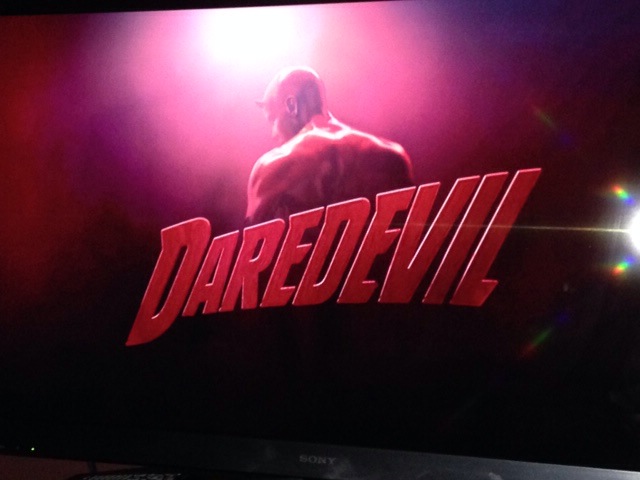
One disappointment: the gorgeous opening credits sequence makes a promise that the show does not fulfill by culminating with a classic image of Daredevil in the pure red costume (see below). The final costume is not that, and while I understood it as part of the ongoing challenge of making comic book heroes look plausible in live action, what they settled on looks like one of the least-loved costumes DD has even worn. Having spent all that time seeing the opening credits as foreshadowing of what would eventually leap across the screen, when the iconic costume wasn’t entirely delivered, late in the last episode, it knocked me out of the narrative for the first time in the entire journey.

However, overall, this series is a must for action fans. I know I will rewatch this season very soon, and look forward to experiencing more with these characters. 

That, my friends, is success.


</ Ryan is author of City of Woe, available on Kindle and in print. For more info, click here.<

Posted in America, comics, fiction, film, Marvel, Marvel Cinematic Universe, pop culture, super-heroes, writing | Tagged , , , , , , | 2 Comments