
-
Archives
- October 2026
- September 2026
- August 2026
- July 2026
- June 2026
- May 2026
- April 2026
- March 2026
- January 2026
- December 2025
- November 2025
- July 2025
- April 2025
- March 2025
- July 2024
- January 2023
- December 2022
- November 2022
- October 2022
- September 2022
- April 2022
- March 2022
- January 2022
- December 2021
- July 2021
- June 2021
- April 2021
- March 2021
- February 2021
- November 2020
- July 2020
- June 2020
- April 2020
- March 2020
- December 2019
- March 2019
- September 2018
- July 2018
- May 2018
- March 2018
- February 2018
- January 2018
- December 2017
- August 2017
- July 2017
- June 2017
- May 2017
- April 2017
- February 2017
- January 2017
- June 2016
- May 2016
- April 2016
- March 2016
- November 2015
- October 2015
- August 2015
- June 2015
- May 2015
- April 2015
- March 2015
- January 2015
- October 2014
- July 2014
- May 2014
- April 2014
- March 2014
- January 2014
- December 2013
- November 2013
- October 2013
- September 2013
- August 2013
- July 2013
- June 2013
- May 2013
- April 2013
- March 2013
- January 2013
- December 2012
- November 2012
- October 2012
- September 2012
- August 2012
- July 2012
- January 2012
- December 2011
- October 2011
- January 2011
-
Meta
Pandemic Plusses: My Supermarket Visit From Klingon Commander Kruge
Posted in writing
Tagged #ChristopherLloyd, #CommanderKruge, #stayhome, #Supermarket
Leave a comment
Pandemic Plusses: Marisa Tomei Saved the Day
The abyss can just grab us these days, pull is into the Coronavirus blues when least expected. You have been warned.
But the most unexpected magic can lift us up just as surprisingly. You have been encouraged.
It happened to me. Early morning tea ritualistically revives me the way coffee works on most humans. Barry’s Irish, thank ye very much. A nice cuppa before sunrise and I am ready for the adventure, God bless St. Caffeine.
Not today. I was pulled under. Plunged into the abyss by morning news and The Grind. Couldn’t shake it. Ran to the safety of the DVR but it wasn’t holding any joy for me there. Flipping stations made it worse. Nothing gave joy. Nothing hit that little war, sunny spot in the heart.
And then there she was. Marisa Tomei. Called to the stand for the climax of My Cousin Vinny. Tomei embodied the character of Mona Lisa Vito with such zest and joy she rendered her contagious. Watching the climatic scene (YouTube “My Cousin Vinny The Defense is Wrong”) where she espouses the unique qualities of rear wheel differential and something she calls posatraction never fails to release the sun I mentioned not too long ago.
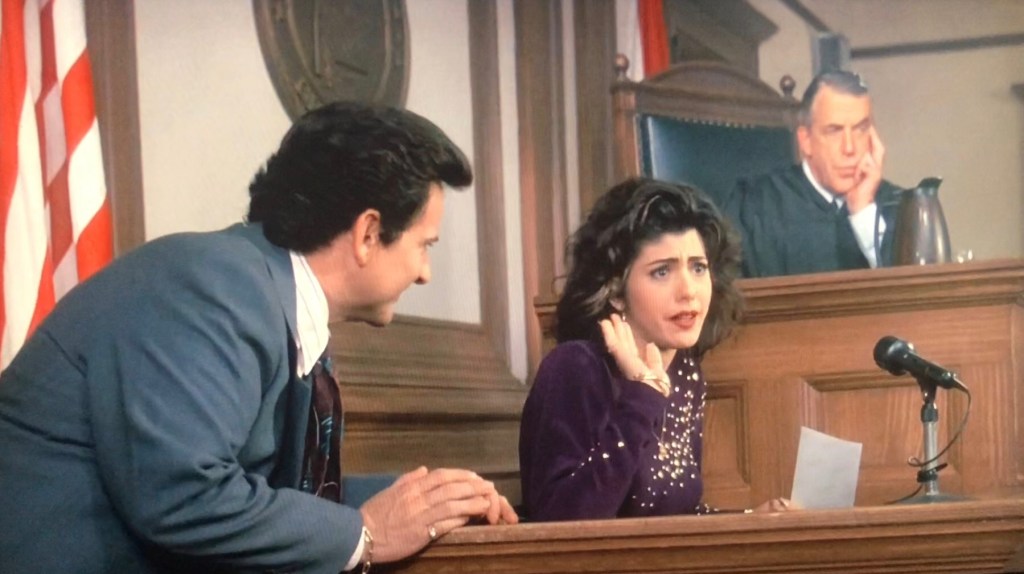
So thank you, Marisa Tomei, for picking me up and energizing me to face The Grind today.
We all have our personal favorites – scenes or films that never fail to make us feel better, like comfort food for the soul. In these weird, trying times, don’t hesitate to go to one of yours when needed.
I write this series in hopes of helping others through the Coronavirus. You are invited to share about the topic (today: film scenes that brighten our day) in the comments section below.
Posted in writing
Tagged #Coronavirusblues, #COVID-19, #favoritefilmscenes, #films, #marisatomei, #mycousinvinny, #stayhome, #thegrind, #workfromhome
2 Comments
Pandemic Plusses: The True Test Begins, and a Mighty Strength Rises
Monday proved to be a grind. And Tuesday is serving up more of the same. This ain’t last week, folks. The adventure’s gone. The novelty’s worn off. And some of our leaders are wandering away from medical intelligence and the world’s evidence, and instead are fantasizing about wonder drugs and this being over soon.
Wonder drugs? Over soon?
I believe most Americans look at the world’s losses and know we’re not on third base heading home, we’re still in the batter’s box waiting on a terrifying inside fastball that hasn’t even left the glove yet.
We see that testing centers are reaching capacity and turning people away before they even open for the day. That tells us how many of our neighbors are worried, or sick, or worse.
Hospitals are begging for masks and protective equipment that the country could be producing with the activation of an already signed order. Instead, we get meandering murmurs of “not wanting to make the cure worse that the problem.” But we the people look around the world and see exactly how big the problem already is. We know that this nation is not close to being done administering tests, no less assessing the results, or treating the ill. And if we’re sent back to our lives before we have confronted this enemy, whatever we have accomplished will be undone. And the numbers of the sick and the dead will explode.
However, there is considerable evidence that Americans know the world’s numbers, dread them, and are turning to state and local officials, and to their own morals, for guidance. We work from home, educate through distance learning, shop In progressively more sane ways, and stay inside. Tuesday morning saw TV commercials become nonpartisan pep and unity rallies, promising support, belief, and strength from furniture outlets and car companies and other familiar brands. And news reports began to emerge showing still other companies manufacturing medical masks and gloves on their own. Communities are working to find ways to feed those in need, and citizens from rock stars to students are utilizing social media to spread hope.
I have faith that most of America sees COVID-19 as the global pandemic that it is, and it seems clear that many of us are doing what needs to be done. It speaks to what lives within Americans, the toughness to take on the unbeatable threat and get to work creating an answer.
In the 1940’s so many countries were threatened by the Axis of Evil, and Americans turned factories and scrap metal and housewives and skinny high school grads and Pearl Harbor into the steely resolve needed to break the allegedly insurmountable Nazi stronghold at Normandy. We stormed those beaches and willingly paid the price to make the world a better place.
We’ve battled for civil and equal rights since the 1960’s with marches and sit-ins, and we lost good people there too. We defied the noose and the gun and still battle stubbornly lingering hatred to make the world a better place.
We’ve been knocked to our knees economically, socially, medically, and spiritually. We’ve seen adversity before and we’ve suffered hard times. None of it has been easy and much of it is ongoing, but when all is said and done, one thing still stands…
The American Spirit.
Not the consumer version or the politically marketed version or any of the cable news versions. Not the Hollywood exploited version or the scandal sheet version or the hot new series now streaming version.
The True American Spirit dwells within everyday people who love their children and work their jobs and dream their dreams and pet their dogs and spend their lives trying to do what is right and what is best for all.
And in our hearts we know the right thing to do now is to take the rough road, to storm this seemingly insurmountable Normandy the way it needs to be stormed. We know the right thing to do is to sit-in against this microscopic violation of our lifestyles, our dreams, our families. In our hearts, that American Spirit burns with the desire to fight this enemy any way we need to, to pay the price to take our lives back, not for a week or a month or a year, but for the future, because we love our children and our families and this worthwhile Idea of America.
But it is going to be a grind and we’re going to need to marshal maturity and all work together and listen to proven experts and not give in to short cuts or false hopes. Our children deserve better than that. Our families deserve better. As do our friends, neighbors, co-workers, and fellow Americans.
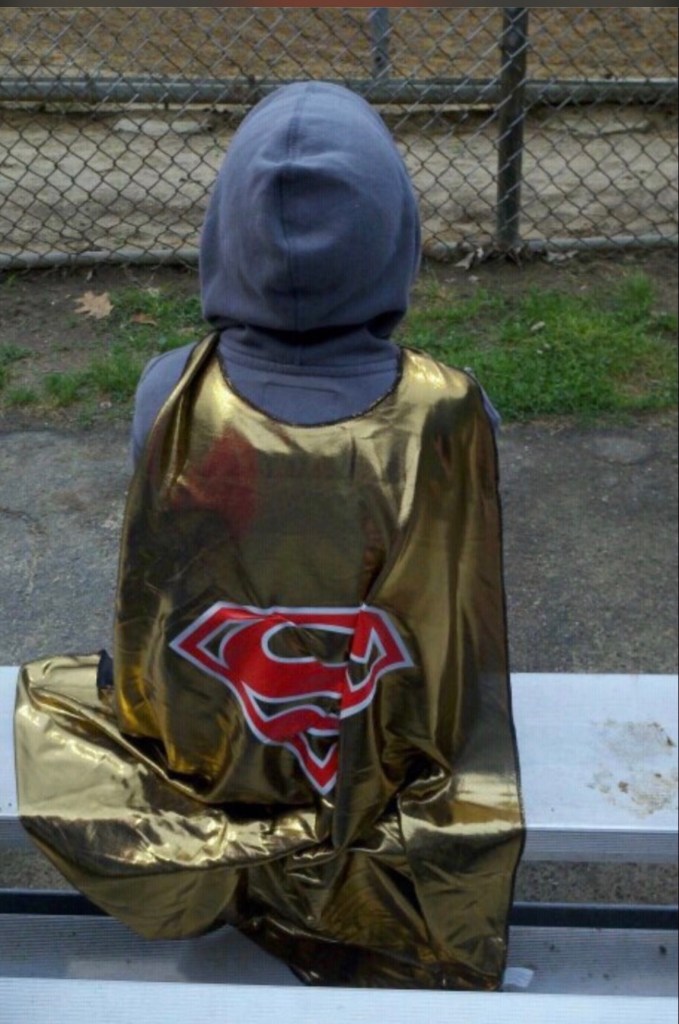
The bell is ringing. It is time we step up and do what needs to be done to meet this particular threat the way Americans always have. Our country is calling for us to make the world a better place once again.
Let’s roll.
Posted in writing
Tagged #America, #AmericanSpirit, #CivilRights, #COVID-19, #equalrights, #pandemic, #stayhome, #WorldWarII
Leave a comment
Pandemic Plusses: Revitalizing Through … Chores?
I got there yesterday, got so bored that doing battle with the bathroom somehow seemed intriguing.
We clean our home weekly (I am contractually obligated to point this out by a certain Sicilian goddess who cleans like a delightfully manic hybrid of the Flash and She-Hulk), but we all know the difference between cleaning and oh my God, is he actually cleaning too?
Yes, we are truly in unheralded times; I wanted to actually do something domestic. In times of desperate need (or in this case, abject boredom), a warrior rises from his chair. This would be a battle royale and every legend requires weapons. I chose mine from the goddess’s limitless arsenal, kept in her physics-defying closet. And I chose wisely.
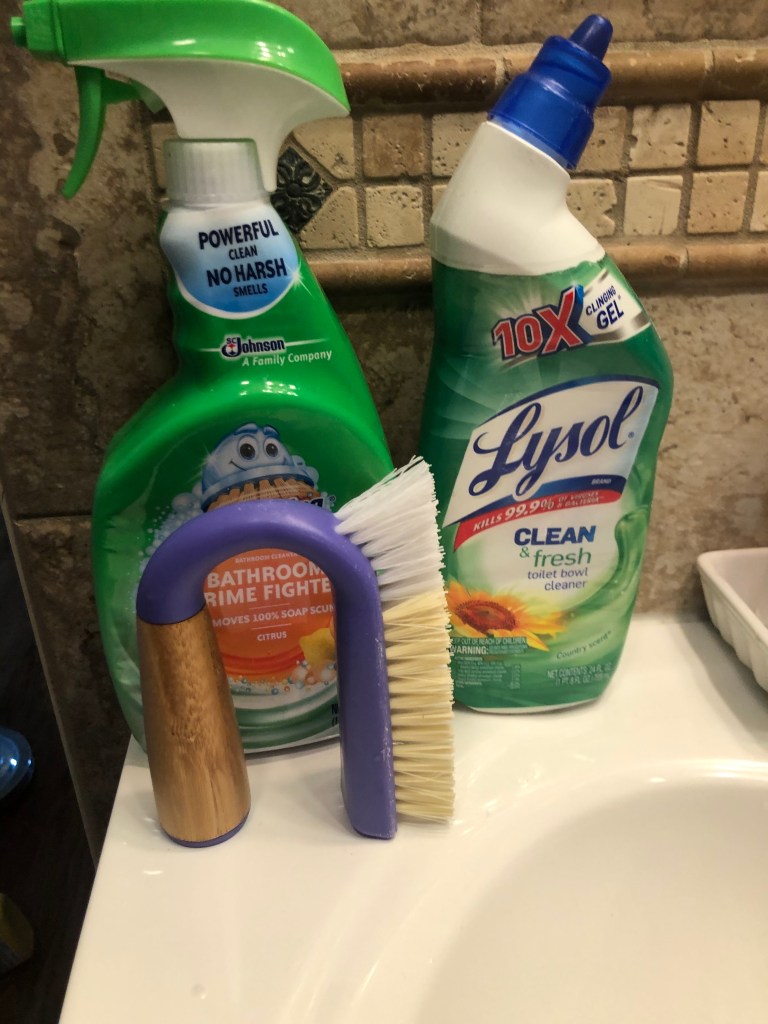
Once more unto the breach, I cried havoc and let loose the dogs of washing, hitting each wall with an untamed horde of scrubbing bubbles. My minions ravaged dirt’s desperate defenses and then came I, breaking their bacterial spirit like a berserker with a brush. (We’re talking about putting in work, folks, utilizing muscles that have been mostly employed to turn pages and lift tea mugs these past few days.) Thumping Peter Gabriel club remixes added a bit of rhythm to each sanitizing slash, a touch of funk to my hygienic heroics. I was a force to be reckoned with, a slow moving, rarely seen, unstoppable tank to the goddess’s daily Level Six hurricane.
Those walls gave up the funk. So did the bathtub, sink, toilet. window, and floor. The shower curtains succumbed to my demands, and the mirror submitted to a near Disney-level polishing. Dirt offered no resistance, surrendering to my bubbling battalion, my brush, and the purifying waters of Isengard (okay, it was tap water, but run with the metaphors, will ya?).
The effect was invigorating.
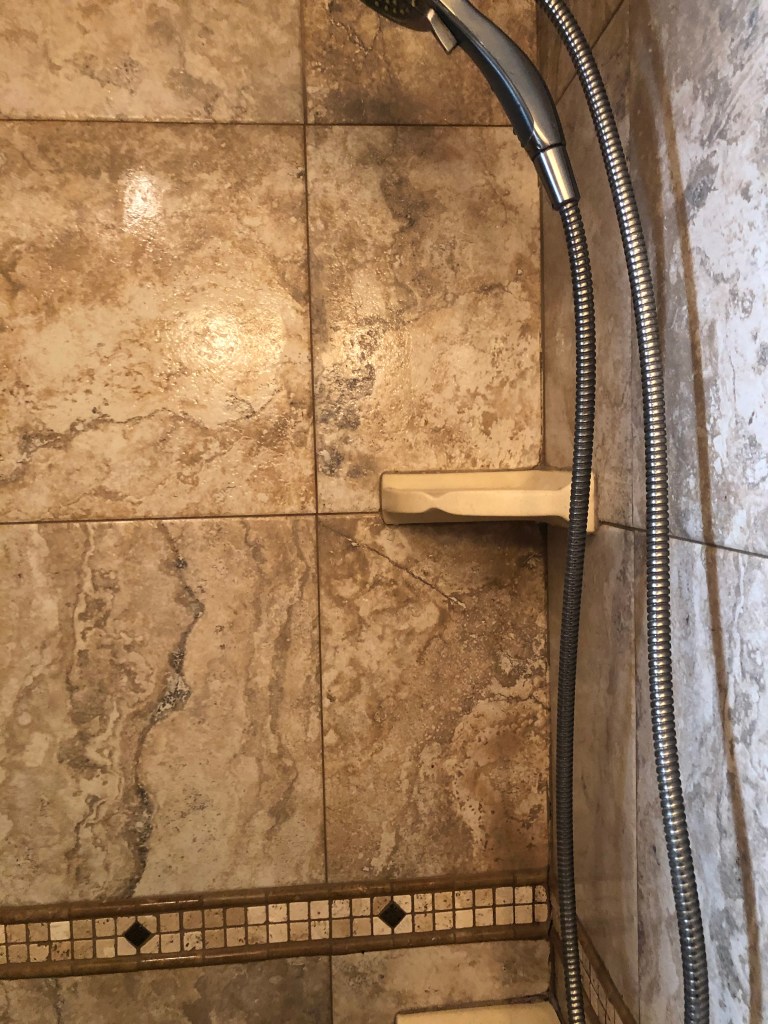
The energy spread. In each room, the Orcs of Disorder cringed and fled. Even Sonny conquered the couch cushion covers.
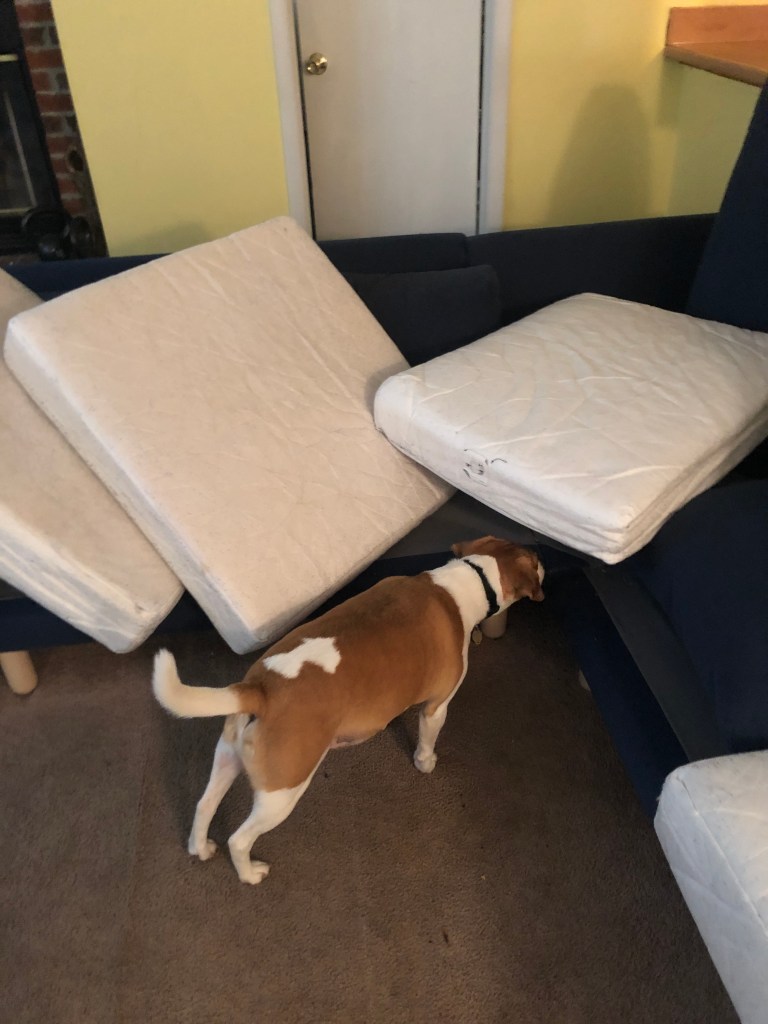
And, of course, the goddess was everywhere all at once, shaming superheroes, using her awesome powers to shampoo rugs, shelve dishes, straighten beds, launder the laundry, fold clothes, clean windows, recover the couch, and absolutely leave me far behind her astounding trail of dirt decimation.
But I still felt great about finally having thoroughly cleaned that one room. This is my message today. Whether you are an immaculation artist Such as myself, working to perfect a single space, or a Tasmanian Devil lifting the house to vacuum under it, spending some time making your sanctuary sanitary, your spot spotless, your pad pure, or your casa cleansed is a solid defense against the pandemic blues.
So pick a project, any project, and leap in.
I am writing this series to share ways to keep our spirits strong during this test of our humanity, our sense of community, and our faith in life. If you have something similar that works for you (for today, cleaning) please share it in the comments section. Your suggestion might save others right when they need it the most.
Posted in writing
Tagged #ClubQuarantine, #coping, #coronavirus, #COVID-19, #pandemicblues
Leave a comment
Pandemic Plusses: Sometimes the Simple Things Pull Us Through
Five days in and the pandemic is getting worse. Governors from New York, California, and Illinois are moving to enforce the quarantine in an aggressive effort to slow the spread of COVID-19 after the numbers of sick jumped dramatically again.
Five days in and walking the empty streets of our town without a mask seems so offensive I purchase four of them, and plastic gloves, at one of the few stores still open.
The goddess and I return home and stark reality has burrowed deeper into our psyche. I see it in her beautiful face, that glow of pure love and positive intent is dimmed by the enormity of how much of our lives went away in a matter of days. Our worlds are reduced to our homes, especially this weekend, when we are all asked to simply stay there in an effort to slow this unseen monster.
The goddess wanders the kitchen, from pantry to fridge and back, each step revealing more sadness. And when the goddess is sad my whole world cries. In a truly rare occurrence, she says she doesn’t want to cook. Then after looking at delivery options, it becomes clear none of that appeals either. She roams the kitchen some more, then finally announces, “I’m just going to make pasta and butter.”
She says it with a tone of defeat, but in her hands this simple comfort food is a miracle. The familiar cooking process get her moving with more purpose and seemingly less despair. She makes a huge pot (she’s Sicilian, that’s the law), cooks the pasta al dente, stirs in the butter perfectly, places red hot pepper and cheese on the table should anyone want to add them.
And that’s it. Nothing fancy and everything we need. Each bite warms, reassures, suggests familial love, and home. Home the heartbeat of our lives, not the prison of COVID-19.
A nice bowl of simple pasta, and our world improves. Sometimes that is all it takes. The huge pot emptied quickly, as the goddess’s gifts chased away the blues today.
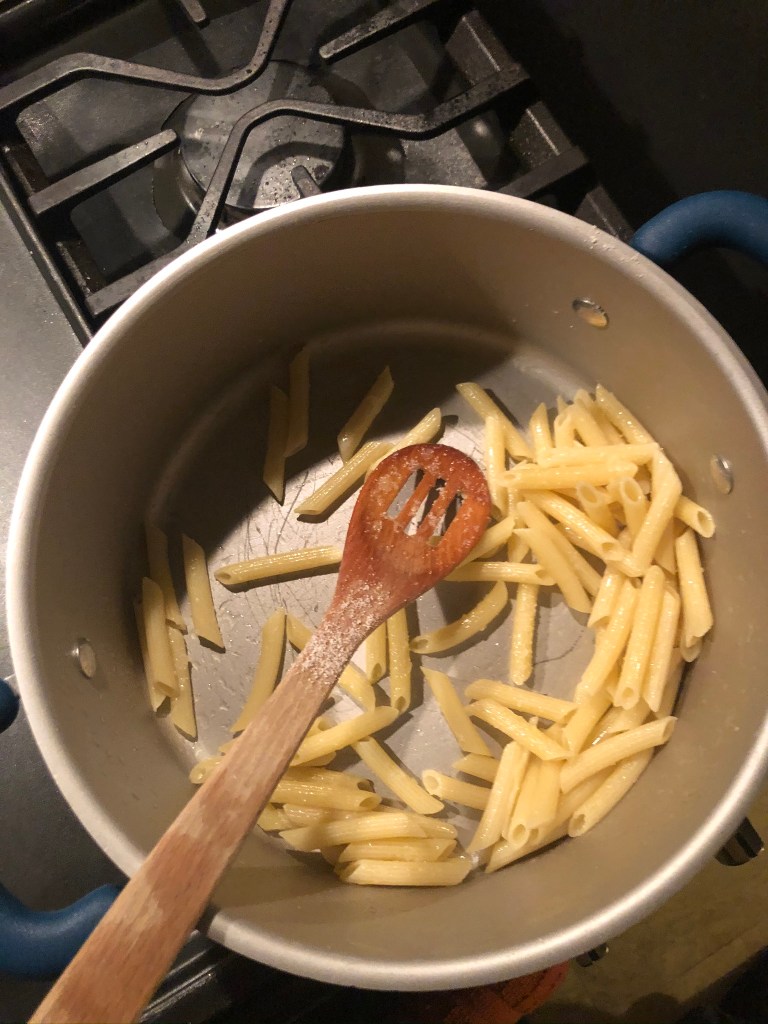
Sometimes the simplest comfort food is exactly what we need to keep going. What is your go-to comfort food at times of stress? Please share it in the comments below, we all need a bit of comfort right now.
I am writing this series to share ways to keep our spirits strong during this test of our humanity, our sense of community, and our faith in life. If you have something similar that works for you (for today, comfort food) please share it in the comments section below. Your suggestion might save others right when they need it most.
Posted in writing
Tagged #comfortfood, #cooking, #coronavirus, #COVID-19, #pasta, #quarantine, #selfcare
Leave a comment
Pandemic Plusses: The Last Thing I Expected to Do During the Pandemic Was Dance
Outside, a human wanders by, alone. Then no one comes into view for long stretches of time. A geezer wanders by with a small dog and a filled plastic bag. Remember back in the good old days when plastic bags were an issue? Then nobody for hours. Squirrels are free to feast on the remains of an impressive acorn harvest that hasn’t been buried by snow, unaware of all the jealous eyes watching from inside.
Nope. I’m not going to do this. Giving in to boredom or despair is worthless. I search for distraction, something to refuel the soul. Awhile back, my son convinced me to try Apple Music, and while I prefer vinyl at home, maybe there’s something there. The other day I used it to listen to Peter Gabriel’s Passion as Sonny and I went for one of those isolated walks. Very spiritual for both of us. Not feeling reflective today, I search his other albums and come across Flotsam and Jetsam, an extensive digital collection of rarities, alternate takes, and remixes.
I push play.
It’s a mellow, deja vu-laden start with his version of “Strawberry Fields” from All This and World War Too, an album of Beatles covers from, well, everybody, it seemed when Roger played it for me back in the late 70’s or early 80’s. Gabriel’s plaintive voice sounds so right for these days. It soothes, empathizes, offers lyrics that nourish even when they are not his own.
Soon the real surprise presents itself; this album is fantastic, offering fresh takes on classics and deep cuts … and club remixes. I haven’t danced in clubs since the first dates with the goddess (she still entrances me with that simple, adorable dance of hers, restricted these days to weddings and other events), but Gabriel has me bopping around the house, feeling more alive, more lively than I have since this started.

Who dances during a pandemic?
Between songs I feel guilty, concerned someone will see me grooving my way past a window and think I am one of those fools not taking this seriously. Then the next song starts and I am moving again. My spirit soars, and I arrive at gratitude.
We have so much wearing us down these days. If you find a groove, or can go back to one that is always reliable, it’s okay to dance. Maybe not in the middle of Shoprite, sure, but at home we all need to break the tension.
So go Shake The Tree, let off some Steam, take a musical Sledgehammer to the day, get some Perspective, dance D.I.Y., move it Big Time, and defiantly celebrate the Kiss of Life. You will still have time to get lost In Your Eyes and to admit that I Grieve.
This collection so renews me I find myself incredibly grateful for the arts I have found in my life. They have saved me so often. And they are saving me again.
I am writing this series to share ways to keep our spirits strong during this test of our humanity, our sense of community, and our faith in life. If you have something similar that what works for you (for today, music) please share it in the comments section. Your suggestion might save others right when they need it most.
Posted in writing
Tagged #amlistening, #amwriting, #classicrock, #coronavirus, #dancing, #flotsamandjetsam, #igrieve, #intoureyes, #music, #pandemic, #petergabriel, #selfcare, #sledgehammer
Leave a comment
Pandemic Plusses: A Simple Kindness Saves the Day
This post threatened to be a rant. I had already written a few graphs going off on “weird times getting weirder” and “no end in sight” and reports of this disease “coming in waves”. And I raged that some are now blaming another country and murmuring about punishment. The blog turned to bile. And I hated every word. This writing is meant to celebrate the things that raise our spirits when we need it the most. Instead it was getting dark and frustrated and angry.
And then the dog fell asleep.
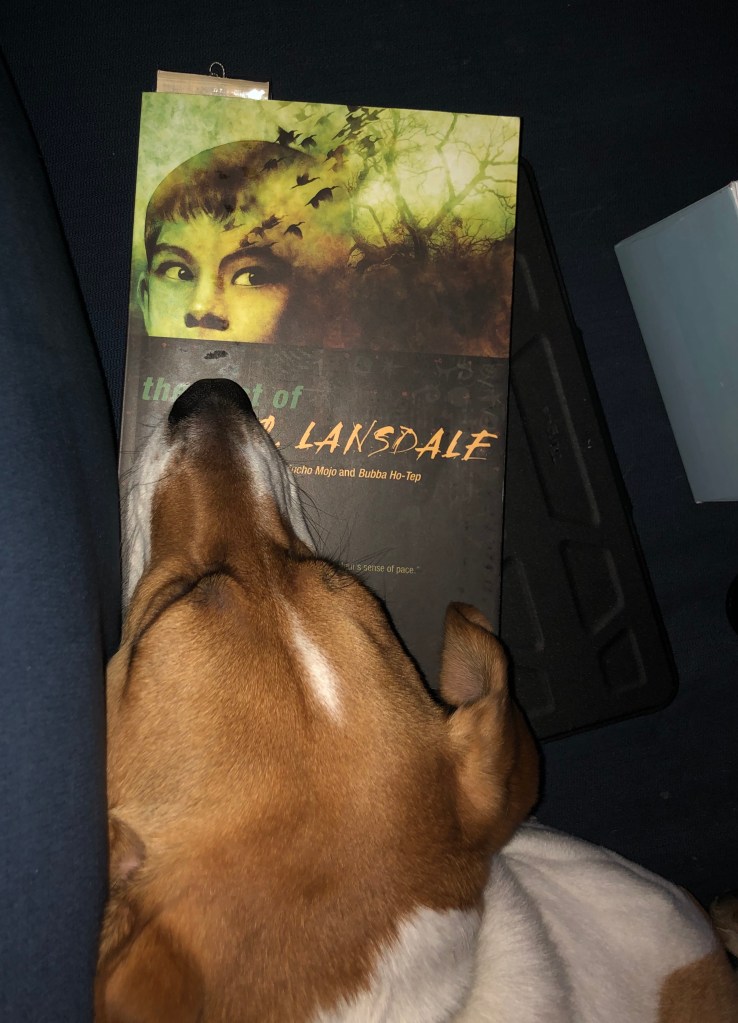
I found his choice of pillow amusing and I tweeted about it. And along came a quick response, “I adore dogs.” And then, “He’s reading.” Without fanfare or celebrity or preciousness, Joe R. Lansdale was enjoying my dog.
I decided to play and replied that Sonny was holding up my social distancing reading marathon. “Well, he’s tired,” replied the master storyteller. We tweeted back and forth a few times, celebrating the glory of canines. It was a simple kindness, a shared pleasure, a couple of chuckles. And it was everything.
At risk of being reduced to as crazed fan, please allow me to explain. The Popcorn King over there did not do this as a plank in some marketing plan, or as part of a promotional tour, or to sell his new book. He responded because he got a kick out of a photo as so many of us do, and said so. Simple. Kind. Humane.
All of these quiet qualities are in high demand these days. We don’t even realize how much we need them until they are sent our way free for nothing and we glimpse hope for a moment.
Be kind. Be humane. It goes longer these days than we realize.
Pandemic Plusses: When an Allergy Sneeze Convinces You it is Something More
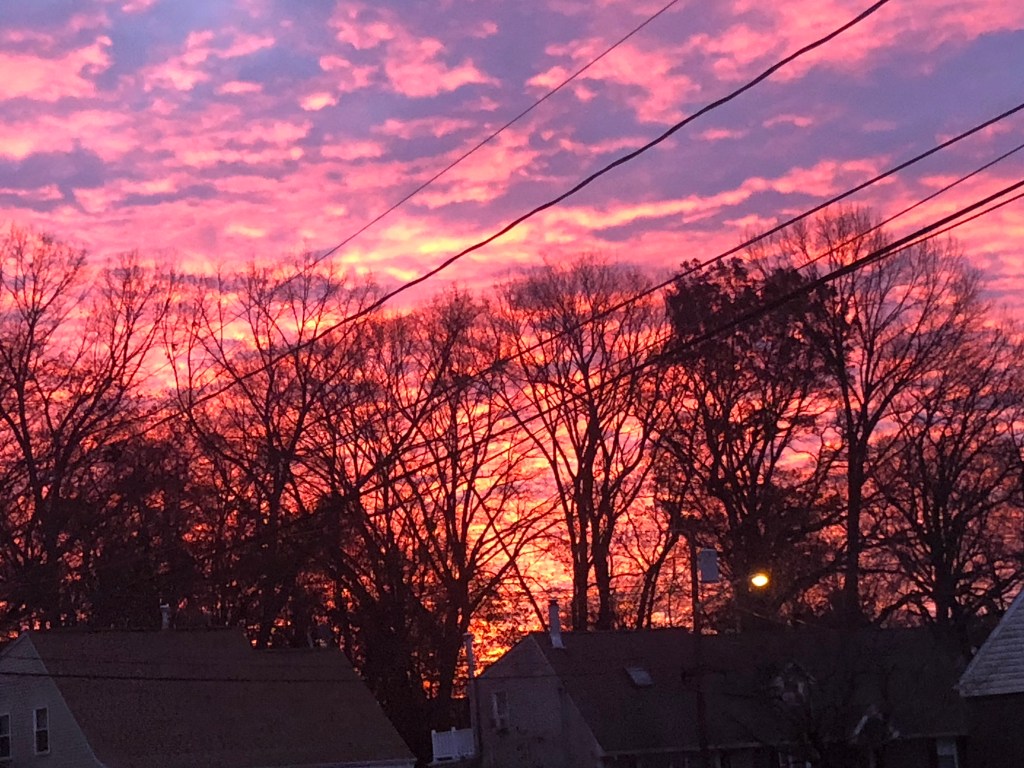
For as long as I can remember, every March the planet has tried to kill me. Spring would arrive and every singing bird meant doom, each bud promised pain, discomfort, a lack of breath … then it would all bloom and exceed my fears.
Spring would gift me a cough, a runny nose, swollen bloodshot eyes (from rubbing them), and pollen seemed to see pinto my blood, thickening it to molasses, running me down, altering my reality in what I only later discovered was similar to being high. It reduced me to a reading machine, which I didn’t mind at all.
But this year every symptom has turned ominous, and morphs into a clear indication that I have COVID-19. The paranoia has gotten so bad that my wife, the goddess, the archangel of common sense, took my temperature three times in one day – all of them normal. We looked up Coronavirus symptoms repeatedly, just to check, and each time my perennial allergies did not add up to this hot new disease.
Why are we so paranoid? The media saturation has got to be one factor. I was so obsessed for awhile not only would I read local and national and global updates but I would send them to loved ones, definitely making me their favorite person.
Common sense won out after about five episodes of subtle, tense, controlled hysteria, and I am confident what I have are allergies,
Most probably.
If I am not sure tomorrow, I’ll panic.
Here we go again, and that is the underreported side effect of this phenomenon – the novelty is wearing off and underneath it is all worry and fear.
It only gets weirder from here, folks. Cut yourselves some slack, go for a walk, talk it out with a trusted spouse or friend, grab a book, music, whatever helps you chill.
Posted in writing
Tagged #allergyseason, #chill, #coronavirus, #misdiagnosis, #paranoia, #selfcare
5 Comments
Pandemic Plusses: Keeping Sane During The Coronavirus Lockdown – Reading Helps

You’ve heard it dozens of times before – as a result of the COVID-19 lockdown, people are buying out entire supermarkets, overstocking their homes for the long isolation meant to #levelthecurve of cases (notice we are not reducing them, just stretching out the timeline of when we get it) so hospitals have a fighting chance.
And yes, some people were selfish jerks last weekend and went out to #placeispacked bars and nightclubs, but many of us slowed our social calendar, cancelled our schedules, and stayed home. Honestly, what’s done is done, and if you are on board now, great, thanks, and if you are just starting to take this seriously, welcome aboard. Instead of pointing fingers, we need to come together in this effort, to all stay home, and minimize the spread of this very active disease as best we can. The lockdown is real. The need for us to be Americans and accomplish the difficult task of Staying Home is real. Let’s all do our part.
So now what do we do?
Yes, we all have “work from home” assignments to take up some of our day, but what do we do with our former gym or cocktails or dinner out or mall walking or favorite store haunting time? Like the setting of some Brian Keene or Stephen King novels, we’re living in ghost town times.
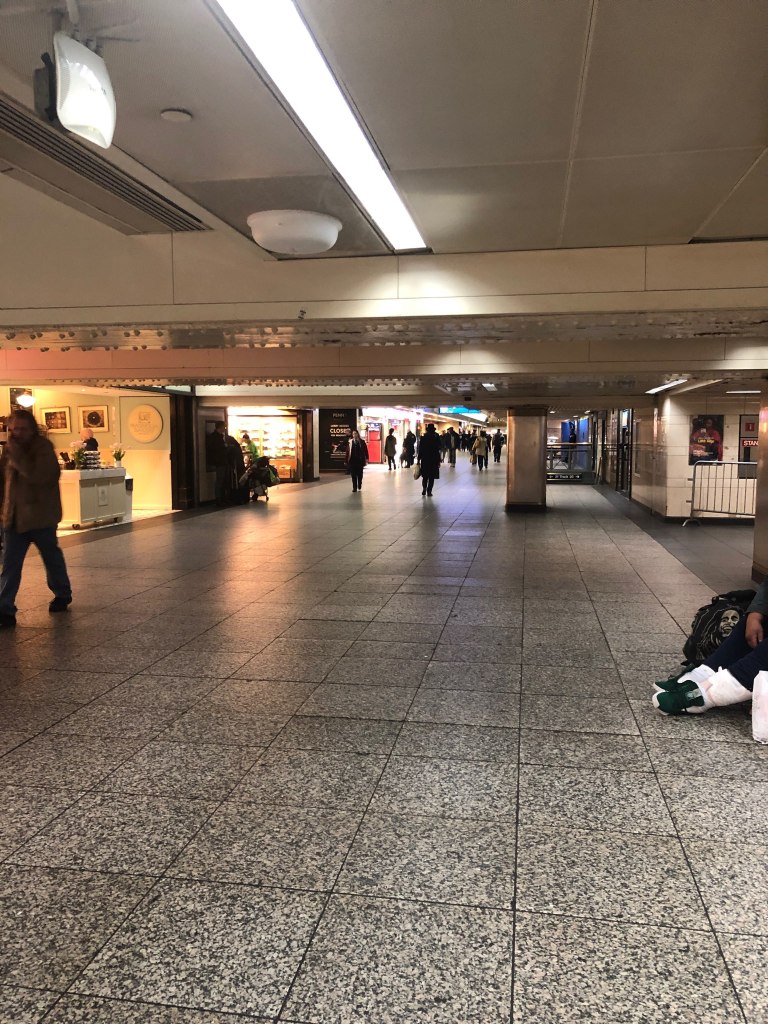
How do we keep ourselves busy in our new sportless, nightlife-deprived reality? Some are doing jigsaw puzzles, or The New York Times Crossword, or playing video games (I heard my sons on with a bunch of their friends yesterday and found comfort in this perfect #socialdistancing socializing).
As for me, I am well stocked in books and music and movies and writing projects. Each day I plan on featuring one of them as a way to offer ideas or comfort or both during this truly weird journey with you. You can get book suggestions through Libby or whatever library app you use in your area, or Kindle them if that’s your thing. Here’s my first:

I have been meaning to read Joe R. Lansdale’s The Bottoms for a long time, and the last two days were my chance. With seasonal allergies teaming up with The Great Lockdown to limit what I could do (and completely freak me out), reading seemed like a great alternative to despair. And The Bottoms delivered.
I have a personal list of Underrated American Classics topped by To Kill a Mockingbird and True Grit, with The Outsiders and many others included. The criteria is that the books have to resonate, especially if the professors don’t acknowledge them. (I’ll post that list and maybe we can add to it together some time soon.) I believe The Bottoms deserves a place near the first two on the list. All three have young, innocent protagonists forced to see the world fortune imperfect mess that it is. All three house the American Ideal in these protagonists, pitting them against the ugly American reality as antagonist. While The Bottoms is clearly the slightly older, much darker cousin to these others, it should still be required reading for those of us who believe in or are fascinated by this ongoing struggle.
What are you reading during The Great Lockdown? Let’s get some ideas together for everyone to share. We’re in this together, so we might as well use our love of reading to help us through.
Let me know what you are reading in the comments section.
Posted in writing
Leave a comment
Testing, Testing….
I have had months of problems with publishing on this blog and very little time to work to correct it (happy problem: writing deadlines! Yay!)
So here’s a test post and a reminder: I am a husband and father first, an author and teacher second, a podcaster whose audience is mostly still waiting to discover my partner and I, and a deep believer in the Idea of America. I believe in trying hard and being able to achieve. I believe in working people with the every day blue collar ethics of doing the job, proving your worth, and loving your family as best you can. I believe in mistakes as opportunities for growth rather than cancellation. I believe we have more in common than we have differences. I believe all of this contributes to the Idea of America.
That idea is in trouble right now.
It is threatened by con artists (they know who they are), politicians (I don’t trust any of them), 24-hour News cycles (no matter what you watch they program you), and social media (good ideas twisted too often into hellscapes of accusations and trolling -and yeah, I know I am on social media right now). On each of these levels when personal or professional gain is put before public service, we all lose.
But that’s just my opinion. Should you disagree, thanks for stopping by, no offense intended, wish we could have engaged in a healthy, constructive conversation. If you don’t mind this perspective, and if you accept that I usually won’t even post about politics, preferring pop culture and story, then I hope you will comment, and come on by again.
There’s enough hate around without us adding to it here.
Peace.
Posted in writing
Tagged #Amazon, #amediting, #America, #amreading, #AmRevising, #amwriting, #author, #authorlife, #books, #comedy, #comics, #crime, #ebook, #editing, #getcaughtreading, #IndieAuthor, #IndiePub, #Kindle, #Marvel, #Nook, #publishing, #selfpublishing, #Storytelling, #womenwriters, #WriteMotivation, #writersblock, #writerslife, #WriterWednesday, #writingtips, writing
Leave a comment

